The Most Important Skill In Golf Cannot Be Taught
It Has To Be Felt — And Most Golfers Never Feel It…
The Swing Thing makes perfect plane, lag and release automatic — on every swing, whether you're thinking about it or not.
Offer Expired — The $60 savings has ended
00
Days
00
Hrs
00
Min
00
Sec
60-day money-back guarantee
"With the Swing Thing, you have no choice but to swing the club through the proper positions to make the ball and chain move correctly. I use it to warm up — and, probably most importantly, to re-groove my swing when I get out of the proper slot."
— SHANE MATZEN, Swing Thing owner
Dear fellow golfer,
Have you ever been told to "feel the lag" — and quietly wondered what, exactly, you were supposed to be feeling?
You're not alone. And it's not your fault.
I've been teaching the Single Plane Swing for over twenty-five years. I've stood on the range with thousands of students. And there's something I tell them that most instructors won't admit:
"The hardest thing for me to do as a teacher is get people to feel. I can hand you a training club and you'll hit shots with it — but you can't feel lag from that. You either hit a good shot or a bad shot."
— TODD GRAVES
Positions can be taught. I can show you the perfect address, the perfect backswing, the perfect impact. You can check yourself in a mirror or on video.
But plane, lag and release aren't positions. They're motions. They happen in a fraction of a second, in the middle of your swing — where no checkpoint, no video and no swing thought can reach them.
And that gap costs you
It's why you can look perfect in practice and still struggle on Saturday. It's why the ball-striking "clicks" for one range session and vanishes by the first tee. It's why the clubface arrives a little different every time — thin one, fat one, block, hook — with the same swing thoughts producing different results.
There's a physical cost, too. When you swing without a proper release, your body absorbs the strain — shoulders, elbows, wrists. It's why we've always advised against heavy weighted clubs and swing-two-irons drills. They don't teach release. They just load more stress onto joints that are already paying the bill.
Titusville, Florida — 1994
The purest feel I ever witnessed
The first time I watched Moe Norman hit balls at a clinic, what struck me wasn't the results. It was how simple it looked. One plane going back. The same plane coming down. The club moving through the same space in the sky, every single swing.
I spent the next ten years learning directly from Moe, and the rest of my life teaching what he knew. Here's one thing I'm certain of: Moe didn't think his way through positions mid-swing. He felt it. The plane, the lag, the release — one motion, automatic.
The question that stayed with me as a teacher: how do you give that feel to a student, without them spending ten years standing next to a genius?
I tried drills, training grips, video, position work. All valuable. And all of it still left a gap between knowing what to do and feeling it happen.
Then I swung something that surprised me — and having been around golf my entire life, it's a rare occasion when something surprises me.
Introducing
The Swing Thing
The first time I swung it, I felt more lag than my own swing normally produces. Not imagined — felt, pulling behind my hands, exactly where it's supposed to be.
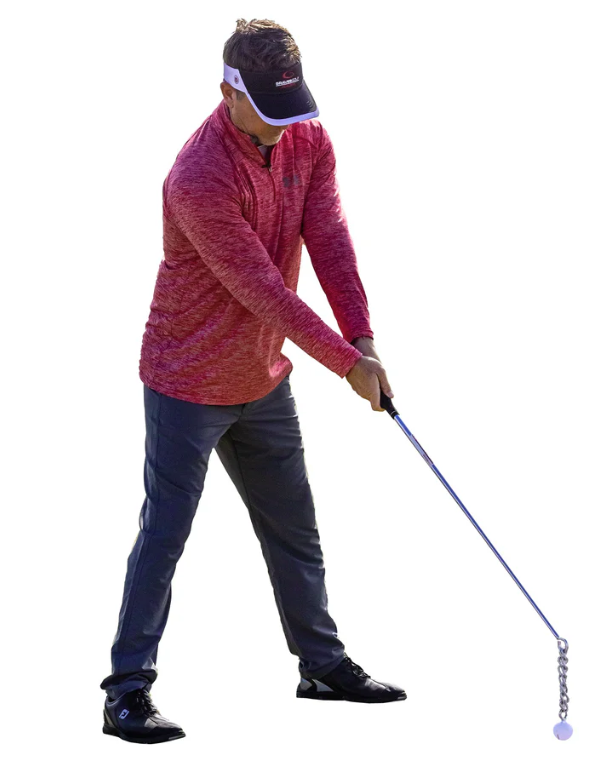
Here's what it is, in plain English:
A shaft weighted like your 6-iron — so the swing you groove is your real swing, not a strongman exercise.
A ball attached by a short chain where the clubhead would be. The chain is the key: the ball must swing on the plane of the shaft. It physically can't go anywhere else.
Our molded training grip, already installed — so your hands go on correctly every rep and stay correct, even as you add speed.

The goal — the only goal — is what we call "plane the chain." When the chain planes with the shaft, you are feeling the perfect single plane motion. When you're off, you know it instantly. No video. No coach. No guesswork.
Look at the chain in this photo. It's not flopping around. It's tracking directly with the shaft — held in line by nothing more than a proper plane, a proper lag, and a body that's actually sequencing.
The chain planing with the shaft at the top of the backswing — the position the Swing Thing puts you in automatically.
Why you can't swing it wrong
Every other training aid asks you to think while you swing. This one won't let you. Three things happen on every rep, automatically.
It forces plane
Your arms take the chain and plane it with the shaft — the same space in the sky, back and through. Drift off plane, and the chain tells on you immediately.
It reveals lag
The weighted ball lags behind the shaft as you transition — a genuine pulling sensation. The exact thing good players feel, and the rest of us only read about.
It requires release
It's basically impossible to hold on through impact. Your hands release at full speed, through the ball, every rep — and the strain comes off your shoulders, elbows and wrists.
"You just set it in motion and hang on. You can't do it wrong. It always happens automatically."
— TODD GRAVES
One more thing worth saying clearly: this is a sequence trainer, not a position trainer. Because it keeps your upper body in continuous motion, you're free to feel your lower body work — lead leg bracing, trail foot staying down — the way an athlete does, instead of freezing over checkpoints. Motion first. Exactly how Moe did it.
What golfers who own one say
"I use it almost daily. I love the help with the grip, and I also enjoy the feeling of lag I get when swinging it. This tool helps me stay back and then smoothly come through."
— MIKE B YOUNG
"I feel like I get a warmup while at the same time getting in some sequencing and lag practice."
— MICHAEL W MISKO
"Love this aid. Always in the bag. Helps me feel lag and hitting positions to swing correctly."
— TIM COLLETT
Three ways I use it — and you will too
1. The two-minute warm-up that saves your front nine
Let me ask you the question I ask every student: which hole is more important — the first or the last? Most golfers say they're equal. I'd argue the first hole matters more, because a cold, stiff, out-of-sync start follows you for three holes and colors the whole round. The Swing Thing is my favorite warm-up in golf: it loosens the shoulders, gets the body rotational, and rehearses perfect plane and release before your first swing that counts.
"I use it mainly when I am going cold onto the course, to loosen the shoulders, back and hips."
— PHIL VANNATTA
2. The feel-then-hit drill
This is where the feel transfers to your ball-striking. Swing the Swing Thing, then immediately hit a few shots with your 6-iron. Back and forth. Because they're weighted the same, the lag, plane and release carry straight over into your real swing — without a single swing thought.
"Mine is always in the car. If I am somewhere waiting and have a few minutes, I swing it. It is also what I use to start any practice session or warmup. Helps me get loose with the correct feeling."
— ANDREW SMITH
3. Lower-body training your upper body can't sabotage
Because the Swing Thing keeps your upper body in motion, you can put all of your attention on the moves most golfers never train — lead knee stability, trail foot on the ground, bracing and rotating. Speed comes from sequence. This trains it.
"I use it to warm up on the range and on the first tee. When I'm able to get outside I like to swing it to keep me in golf shape. Very beneficial training aid."
— ROBERT CUNNIFF
A few honest warnings before you order
It looks unusual. A grip, a shaft, and a ball on a chain. Your playing partners will ask what it is — right up until they swing it. Then they'll ask to borrow it.
It is not a position trainer. If you're still building your address and grip fundamentals, our coaching and position work do that job. The Swing Thing teaches motion — plane, lag, release, sequence. It's the tool for putting your fundamentals into motion.
And it won't swing the club for you on Saturday. A couple of minutes, a few days a week — warm-ups and practice sessions — is what turns the feel into your feel.
This week · Through Sunday, August 30
Get the Swing Thing
Molded training grip installed. Weighted like your 6-iron. Ready to swing the minute the box opens.
Offer Expired — The $60 savings has ended
00
Days
00
Hrs
00
Min
00
Sec
Secure checkout · Fast shipping from Oklahoma City · Support: (866) 377-2316
60-day money-back guarantee
Swing it for two months. Warm up with it, do the feel-then-hit drill. If it doesn't give you a clearer feel for plane, lag and release than anything you've tried, just let me know and I'll refund you. No questions asked.
"I use it to warm up before practice. I also use it with my speed trainers as part of building up swing speed."
— LEN DEROECK
Questions golfers ask
Is this just another weighted club?
No — and the difference matters. Heavy weighted clubs strain shoulders, elbows and wrists while teaching you nothing about release. The Swing Thing is weighted like a standard 6-iron. Its power isn't weight — it's the chain, which forces plane, reveals lag, and makes a full release unavoidable. A proper release actually reduces strain on the body.
Will it help my distance?
Distance comes from three places: equipment, flexibility, and a proper impact with full release. The Swing Thing directly trains two of the three — it works your golf flexibility every time you swing it, and it teaches your hands to release the club at full speed through impact. When students ask me "if I get one thing for distance, what should it be?" — this is my answer.
I'm a Single Plane student. Where does this fit?
It was built for our method. Use it as your warm-up before practice and rounds, and alternate it with your 6-iron during feel work. It rehearses the exact plane, lag and release the Single Plane Swing is built on.
I don't swing the Moe Norman way. Will it still work for me?
Yes. Plane, lag and release are fundamentals of every good golf swing — Moe simply did them more purely than anyone. Whatever your swing looks like, the chain still planes, the lag is still real, and the release still transfers to your clubs.
Do I need a lot of space?
If you have room to make a full swing safely — a yard, a garage with ceiling height, or the range — you have room for the Swing Thing. Most golfers use it exactly where they warm up.
What if it's not for me?
Then it costs you nothing — you're covered by the 60-day guarantee above. The only way to know what lag actually feels like is to feel it.
The feel Moe had. In your hands.
Every golfer I've ever taught knows more about the golf swing than they can feel. That gap — between knowing and feeling — is where scores go to die.
You can keep collecting tips and positions and hope the feel eventually shows up on its own. Or you can swing the one tool that installs it — automatically, on every rep, because it won't let you do it any other way.
$99.95 through Sunday, August 30 · 60-day money-back guarantee
To your best golf,
Todd Graves
Co-founder, Graves Golf · Author, The Single Plane Golf Swing: Play Better Golf the Moe Norman Way
P.S. — I've been around golf my whole life, and it's a rare occasion when something surprises me. The first time I swung the Swing Thing, it surprised me: I felt more lag than my own swing normally produces. I was, and still am, genuinely impressed by how well this works.
P.P.S. — The $60 savings ends Sunday night, August 30. After that, the Swing Thing returns to its regular price of $159.95. Either way, you're protected by the 60-day guarantee — but if you're going to try it, this is the week. Get yours for $99.95 →
Testimonials reflect individual experiences and may not represent typical results. Your results may vary.